
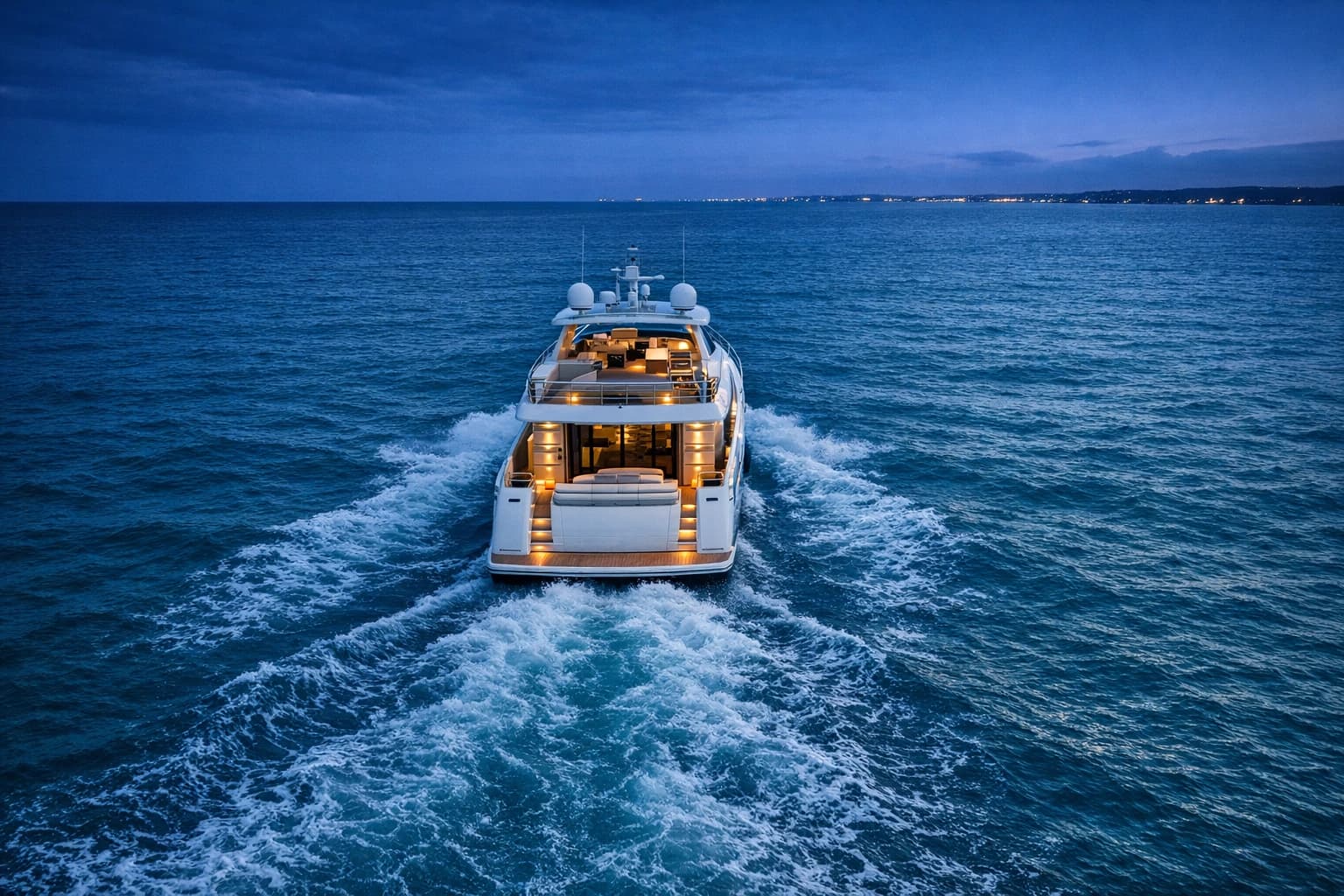
What does yacht videography cost?
Prices vary more than in most video work, because a boat shoot needs a captain, fuel, weather, and often a second vessel to film from. These are typical US ranges rather than quotes:
| Format | Typical US cost |
|---|---|
| Drone-only exterior footage | $800 – $2,500 |
| Half-day shoot, basic edit | $1,000 – $3,000 |
| Full day with drone and full edit | $3,000 – $7,000 |
| Multi-day cinematic production | $7,000 – $15,000+ |
| Underwater footage | $1,500 – $5,000 |
| Photo and video, 60ft sportfish, Fort Lauderdale | $780 – $1,050 |
| Helicopter aerials, superyacht | $15,000+ |
| yacht-tour.com, built from your listing photos | $149 |
The useful number is not the day rate, it is the cost per listing. A brokerage with forty boats on the books is looking at a five-figure bill to film even half of them, every time the inventory turns over.
What do you actually get for that?
At the lower end, a half day usually buys a single visit, exterior stills and clips, a walk through the main spaces, and a short edit. Nobody repositions the boat and nobody waits for light.
The upper bands buy things that genuinely cannot be faked: the boat underway, a drone orbit at golden hour, a second camera vessel, a crew on deck, and a colourist afterwards. On a flagship listing that is money well spent.
- Half day · one location, one light condition, boat stays on the dock
- Full day · drone, interior and exterior, usually the boat underway
- Multi-day · scripted, crewed, underwater, shot to a storyboard
What is the alternative to a shoot?
Building the film from the photographs the listing already has. The gallery exists, it was shot for exactly this boat, it is already approved for marketing use, and it is sitting on the listing page doing nothing. The only thing it lacks is motion.
Here is one, built end to end from a listing gallery. No shoot, no visit to the boat, no captain and no weather window. Everything you are watching came out of photographs that were already published:
What it costs. A single listing is $149. Packs bring that down, because the work is the same whichever boat it is:
| What you order | Price | Per listing |
|---|---|---|
| One listing | $149 | $149 |
| Five listings | $595 | $119 |
| Ten listings | $990 | $99 |
Set that against the table further up this page. A half-day shoot at the bottom of its range, $1,000, buys one boat. The same money here covers ten and leaves change. For a brokerage, that is the difference between filming the flagship and filming the inventory.
What it costs you in time. This is the part brokers underestimate. A shoot is a scheduling problem: a captain, a clean boat, a weather window, a crew and an editor's queue, usually two to four weeks. Here the input is a listing URL.
- You send a link. We read the gallery off the listing page. No uploads, no file transfer, no shared drive.
- Nobody goes near the boat. It can be in the water, on the hard, under cover, or three states away.
- Usually inside a day. Not a fortnight, and not dependent on the weather.
- Your branding on it. Your logo, your contact details, your colours.
- Standard MP4 files. Straight onto YachtWorld, Boat Trader, Instagram, YouTube or into an email. Not a player you have to embed.
- Revisions included. A caption with the wrong figure or a section you want cut gets recut, not argued about.
The part that matters most. Nothing is invented. Every prompt that touches one of your photographs carries preservation rules: stay inside the visible space, never pass through a wall or a door into a room the photo does not show, never add furniture, equipment, people or a view that is not in the source frame. On a seven-figure asset an invented feature is a misrepresentation, not a style choice.
And if the gallery is too thin or too low-resolution to produce something you would actually publish, we tell you before you pay rather than hand you a film you would not use.
It does not replace a real shoot. It covers the boats that were never going to get one.
Why do most listings never get a video?
Not because brokers do not want one. Because the arithmetic does not work below a certain asking price. Spending $2,000 filming a $90,000 boat is a large slice of the commission, so the shoot goes to the flagship and everything else gets a photo gallery.
The result is an inventory where two or three boats look extraordinary and the other thirty-seven look like a classified ad. Nobody decided those thirty-seven did not deserve a video. The cost per boat decided it for them.
When is a real shoot still worth it?
- The boat is a flagship and the commission justifies a crew
- You need the vessel underway, which photographs cannot give you
- The listing is a charter programme that sells the experience, not the layout
- The gallery is genuinely poor, too thin or too low-resolution to build from
If you are in one of those four cases, book the shoot. The honest answer to this query is that both exist for different boats, and anyone telling you otherwise is selling one of them.
How long does it take?
A traditional shoot is a scheduling problem before it is a production one: a captain, a weather window, a clean boat and an editor's queue. Two to four weeks from booking to delivery is normal, longer if the weather does not cooperate.
A film built from existing photographs skips all of that, because the only input is a gallery that already exists.